The Science of Yield Prediction: Tools Farmers Are Using Today to Maximize Every Acre
Discover how AI, IoT, satellite imaging, and predictive analytics are transforming yield prediction in modern agriculture. Explore real-world tools and technologies that help farmers make smarter, data-driven decisions for higher productivity and sustainability.
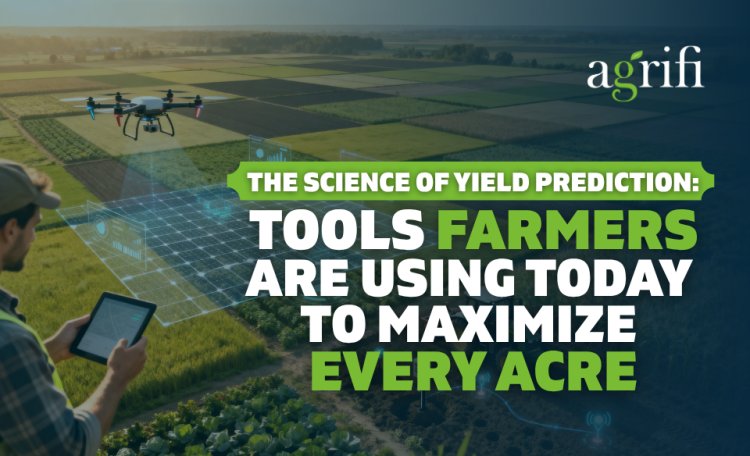
Yield prediction has evolved from guesswork to data-verified forecasting, helping farmers plan input use, optimize irrigation, anticipate disease outbreaks, and secure better market prices.
The fusion of AI, IoT, and geospatial intelligence is now redefining how we forecast the future of every crop.
The Evolution of Yield Prediction: From Observation to Algorithms
Traditional yield prediction was manual and empirical, based on past harvests, rainfall records, and farmer experience. Today, it has evolved into a multi-variable data model that integrates soil conditions, historical yield, weather forecasts, plant health indices, and even market dynamics.
Key Milestones in the Evolution:
- Early 2000s: Satellite and GIS data introduced spatial mapping for agriculture.
- 2010s: AI and ML enabled pattern recognition from multispectral imagery.
- 2020s: IoT sensors, drones, and blockchain brought real-time, transparent yield estimation and traceability.
The modern farmer now uses digital twins of their fields; dynamic, AI-driven replicas that simulate growth, stress, and yield outcomes before the actual harvest.
Core Science Behind Yield Prediction
Yield prediction isn’t guesswork; it’s a quantitative fusion of biology, meteorology, and data science.
Core Data Inputs in Modern Models:
- Soil Quality: Nutrient levels, pH, moisture, microbial activity
- Weather Data: Real-time and forecast-based climatic conditions
- IoT Sensors: Ground-level monitoring of temperature, humidity, and water stress
- Crop Phenology: Growth stages tracked through satellite or drone imagery.
- Remote Sensing: NDVI and multispectral imagery for canopy growth
- Crop Management Inputs: Irrigation schedules, fertilizer applications, pesticide logs
- Historical Data: Multi-season yield records and geospatial comparisons
Advanced algorithms, including random forest regression, convolutional neural networks (CNNs), and Bayesian inference models process these data layers to generate precise yield forecasts, often accurate to within 5–10% of actual harvest outcomes.
Cutting-Edge Tools Farmers Are Using Today
Here’s a look at the most impactful yield prediction tools and technologies shaping farms worldwide:
- 1. AI-Driven Predictive Analytics Platforms
Tools like AgriFi AI, IBM Watson Decision Platform for Agriculture, and Microsoft FarmBeats use AI models to analyze multi-source data and deliver precision yield forecasts.
They enable:
- Crop-specific yield forecasting
- Disease risk prediction
- Fertilizer optimization
- Resource allocation planning
Example:
AgriFi integrates IoT data from soil sensors, drone imagery, and blockchain-based traceability to create real-time predictive dashboards for farmers and cooperatives.
- 2. Remote Sensing and Satellite Imaging
Organizations like Planet Labs, Sentinel-2 (ESA), and Landsat (NASA) provide high-resolution spectral data for large-scale monitoring.
With NDVI (Normalized Difference Vegetation Index), these tools can estimate biomass growth and stress patterns that directly correlate with yield potential.
- 3. Internet of Things (IoT) Sensors
IoT devices deployed across the field measure soil temperature, nutrient levels, and moisture in real time.
The data feeds into predictive models that simulate how crops will perform under different climatic or irrigation scenarios.
Impact Example:
IoT-based irrigation management systems in India have improved wheat yield by 20–25% while saving up to 30% water usage.
- 4. Drone-Based Crop Monitoring
Drones equipped with LiDAR, multispectral, or thermal sensors offer real-time visual analytics.
These drones can detect crop anomalies weeks before they’re visible to the human eye, allowing predictive interventions.
- 5. Blockchain-Backed Data Platforms
Yield data stored on blockchain networks (like Polygon or Ethereum) ensures traceability and transparency for crop insurance, financing, and contracts.
Farmers can validate yield predictions through on-chain proof of productivity — a game-changer for DeFi-based agricultural financing models.
- 6. Climate Forecasting Models
Advanced AI systems integrate global meteorological data to predict yield fluctuations based on El Niño, drought cycles, or extreme weather risks.
These forecasts are crucial for policymakers, insurers, and traders managing agricultural portfolios.
Why Accurate Yield Prediction Matters
Yield prediction is more than a number, it’s a strategic decision tool for the entire agricultural value chain.
Benefits Across Stakeholders:
- Farmers: Optimize resources and reduce uncertainty.
- Banks & Insurers: Assess risk and price agricultural loans accurately.
- Supply Chains: Plan procurement and logistics in advance.
- Researchers: Model climate impact on crop productivity.
- Governments: Ensure food security and manage subsidies efficiently.
According to FAO, AI-driven yield forecasting can reduce post-harvest loss by 15–20% and enhance global food resilience.
Global Case Studies: Data in Action
Case Study #1: United States- AI & Big Data in Corn Belt Precision
Region: Iowa, Illinois, Nebraska
Tool Used: John Deere Operations Center + Climate FieldView (Bayer)
Farmers across the U.S. Midwest now use predictive yield maps that combine satellite data, machine learning, and sensor analytics.
- Predictive analytics identified nitrogen deficiencies weeks in advance, enabling timely correction.
- Corn yield improved by 12–15%, while fertilizer usage dropped by 18%.
- These AI models integrate with combines, enabling autonomous yield-based harvesting decisions.
“We’re not just growing crops; we’re growing data,” says an Iowa corn farmer featured in Bayer’s sustainability report.
Case Study #2: India- IoT + Satellite for Smallholder Empowerment
Region: Maharashtra & Andhra Pradesh
Tool Used: Fasal, AgriFi AI Platform
Smallholder farmers using IoT-based soil sensors connected to AgriFi’s predictive dashboards saw remarkable results:
- Real-time alerts on irrigation timing and nutrient imbalances.
- Yield gains of 22–27% across chili, cotton, and pomegranate crops.
- Integration with weather forecasts reduced water waste by 30% and energy consumption by 18%.
AgriFi’s decentralized yield model also linked these predictions to AGF Token-based smart contracts, bringing financial transparency into agri-financing.
Case Study #3: Japan- Robotics, AI, and Microclimate Prediction
Region: Shizuoka & Ibaraki Prefectures
Tool Used: Hakase AI Agri Module + Greenhouse IoT Suite
Japan’s smart farming ecosystem uses digital twins to simulate greenhouse environments.
- AI models predict crop maturity by analyzing temperature, CO₂, and LED light spectra.
- Strawberry and tomato yields improved by up to 20%, while waste dropped by 15%.
- Farmers receive daily “digital forecasts” of yield and fruit quality via smartphone.
This predictive system aligns with Japan’s Smart Agriculture Vision 2025, enabling data-driven horticulture.
Case Study #4: Europe- Sentinel Satellites & Climate-Smart Policy
Region: Netherlands, Spain, France
Tool Used: Copernicus Sentinel-2, ESA AgriSens Models
European farmers use satellite-derived vegetation indices to monitor wheat, barley, and maize yields across 10,000+ hectares.
- NDVI data predicts yield variance up to six weeks before harvest.
- Helps governments adjust subsidies and food security planning under the EU’s CAP (Common Agricultural Policy).
This approach ensures climate resilience while integrating data into carbon credit validation systems for sustainable farming.
Case Study #5: Africa: AI-Powered Food Security Modeling
Region: Kenya & Nigeria
Tool Used: IBM Watson Decision Platform for Agriculture
AI and remote sensing tools predict maize yields across 50,000 farms.
- Government agencies now use these forecasts for early drought-response planning.
- Yield prediction accuracy improved by 40%, helping stabilize food supply chains.
- In Kenya, this system prevented losses worth $12 million during the 2023 drought season.

The next generation of farming systems won’t just predict outcomes; they’ll prescribe them.
Imagine a system that not only forecasts yield but advises when to plant, irrigate, harvest, and even sell; automatically adjusting to weather, market, and logistics data.
Platforms like AgriFi are already building this vision, connecting real-time IoT analytics, AI-driven models, and tokenized rewards into a unified, decentralized ecosystem that benefits both farmers and investors.
The future isn’t just about predicting yield; it’s about redefining agricultural intelligence itself.
Predictive analytics is no longer a privilege of large farms; it’s becoming the foundation of global food security.
By combining AI, IoT, satellite imaging, and blockchain transparency, we’re entering an era where every seed planted comes with foresight, not just hope.
AgriFi and similar platforms are leading this transformation, creating a bridge between data, decentralization, and sustainable food systems.
What's Your Reaction?